Scalable power architecture
Modular UPS systems, scaled to the load.
Hot-swappable, N+1 redundant, pay-as-you-grow uninterruptible power supply. We specify, install and commission modular UPS from Socomec, APC, Eaton, Vertiv and PowerShield across Australia.
What a modular UPS is
One frame, many power modules.
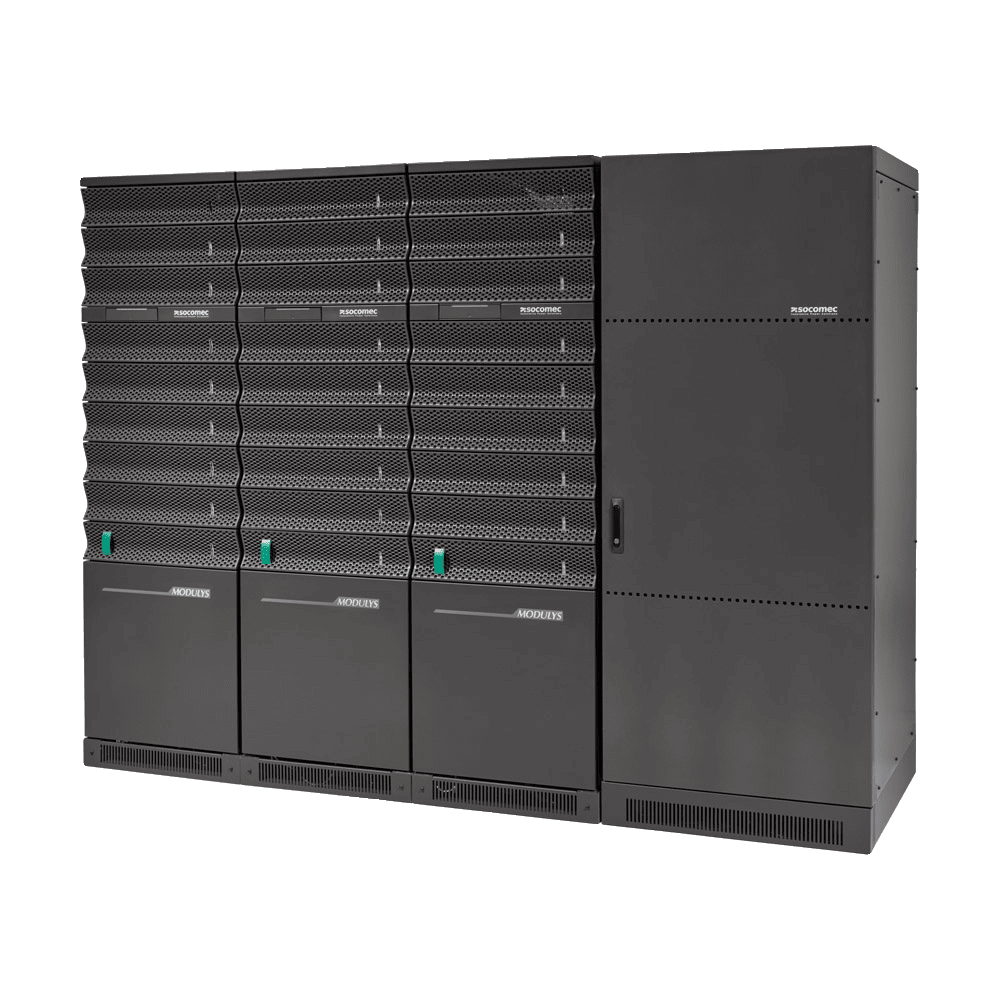
A modular UPS is built from several smaller power modules running in parallel inside a single frame, rather than one fixed-capacity (monolithic) block. Each module is a complete rectifier, inverter and control unit. You commission only the capacity the site needs now and add modules later as the load grows, without a second installation project.
Because the modules share the load, fitting one module more than the load requires gives you N+1 redundancy in the same footprint: any single module can fail or be pulled for service while the rest carry the full load with no interruption. That same design slashes mean time to repair, a faulty module is swapped in minutes rather than waiting hours for a board-level repair on a monolithic unit.
Modular systems also help efficiency. Running a right-sized number of modules near their optimal load point keeps the system in its best efficiency band, instead of running one large UPS lightly loaded. For most growing data centre, healthcare and commercial loads, this combination of scalability, redundancy and serviceability is why modular has become the default architecture.
The modular ranges we install
Compare modular UPS systems.
Power ranges, module scaling and redundancy for the modular lines we supply and service Australia-wide. Each links to the full series page with the variants table and verified datasheet.
| Series | Power range | Scaling & redundancy | Best fit |
|---|---|---|---|
| Socomec MODULYS GP | 25-600 kVA | 25 kVA hot-swap modules, N+1, high MTBF via module redundancy | Edge to mid data centre, finance, healthcare |
| APC Galaxy VS | 10-150 kW | Vertical scaling plus parallel to 4 units, Live Swap power module | Server rooms, edge, small data halls |
| APC Galaxy VL | 200-500 kW | 50 kW Live Swap power modules, N+1, ECOnversion ~99% | Large and hyperscale data centres |
| Eaton 93PM | 30-500 kVA | Hot-swappable UPM modules, Hot Sync parallel, up to ~97% online | Data centres, healthcare, industrial |
| Vertiv Liebert Trinergy Cube | up to 1.6 MW per unit | Hot-scalable cores, parallel, dynamic online mode | Large and hyperscale data centres |
| PowerShield Modular | 10-300 kW | Hot-swappable power modules, Australian-made | Industrial, mining, defence, data halls |
Power ranges are manufacturer-rated. We confirm the exact configuration, module count and runtime against your load and redundancy target during design.
Choosing an architecture
When modular beats monolithic.
Modular is not always the answer. Here is where each architecture earns its place.
Choose modular when
- The load will grow and you want to add capacity in steps.
- You need N+1 redundancy in a single footprint.
- Fast repair matters: hot-swap a module in minutes.
- You want to run near the efficiency sweet spot at part load.
- Floor space or power density is constrained.
Monolithic can still win when
- The load is known, stable and unlikely to grow.
- Lowest capital cost per kVA at full load is the priority.
- A single large fixed block suits the site and budget.
- Redundancy is provided at system level (a second UPS).
- Maximum efficiency at a high fixed load is the goal.
Frequently asked questions
5 questions answered.
Q01
What is a modular UPS system?
A modular UPS is an uninterruptible power supply built from several smaller power modules that work in parallel inside one frame or cabinet, instead of a single fixed-capacity (monolithic) block. Each module is a self-contained rectifier, inverter and control unit. You install only the capacity you need today and add modules later as the load grows. Because the modules share the load and can be added or removed individually, a modular UPS supports both pay-as-you-grow scaling and built-in N+1 redundancy.
Q02
How does modular UPS scalability and redundancy work?
Scalability comes from adding power modules to a frame that is already installed and wired, so capacity grows without a forklift upgrade or a second installation project. Redundancy comes from fitting one module more than the load requires: this is N+1. If the load needs four modules, you fit five, so any single module can fail or be removed for service while the remaining modules carry the full load with no interruption. Higher resilience tiers parallel whole frames for N+X or 2N (dual-bus) topologies.
Q03
Modular versus monolithic UPS: which is better?
It depends on the load profile. Modular UPS wins where the load will grow, where fast repair matters, or where N+1 redundancy is needed in a small footprint: a faulty module is swapped in minutes rather than waiting hours for a repair, and you can run closer to the efficiency sweet spot by matching online modules to the actual load. Monolithic UPS can be the better choice for a known, stable load where the lowest capital cost per kVA at full load is the priority. We size both options during design so the trade-off is clear.
Q04
Can modular UPS modules be replaced without downtime?
Yes, when the system is configured for it. With N+1 redundancy and hot-swappable modules, a single module can be removed and replaced while the protected load continues running on the remaining modules. Features such as APC Live Swap and Eaton Hot Sync are designed for exactly this. For non-redundant configurations, or for work on the common bus, we use an external maintenance bypass panel so the UPS can be isolated for service while the load runs on raw mains. We confirm the safe method of work before every visit.
Q05
What modular UPS brands do you install in Australia?
We supply, install, commission and maintain the major modular ranges: Socomec MODULYS GP (25-600 kVA), APC Galaxy VS (10-150 kW) and Galaxy VL (200-500 kW), Eaton 93PM (30-500 kVA), Vertiv Liebert Trinergy Cube (up to 1.6 MW per unit) and the Australian-made PowerShield Modular (10-300 kW). Our engineers are manufacturer-trained, and commissioning is carried out to the manufacturer requirements needed to validate warranty. We work Australia-wide from local teams in Brisbane, Sydney and Melbourne.
Modular ranges
Related services
Specify a modular UPS