Industry
UPS for Rail, Tunnel & Transport Systems | Australia
Transportation systems (rail signalling, tunnel control, traffic management, and ITS infrastructure) depend on UPS for safety-critical signalling and control. Failure consequences are public-safety serious. UPS Services supports rail authorities, road authorities and transport contractors across Australia.
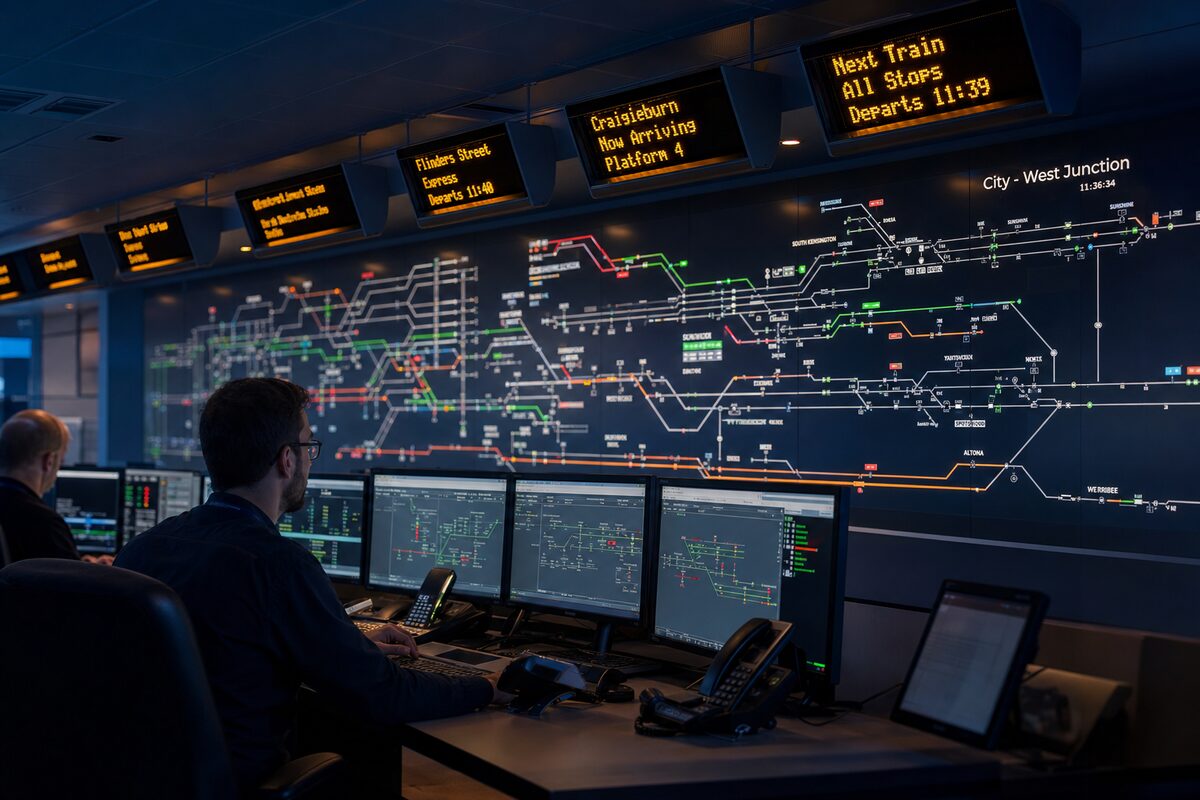
Rail signalling is perhaps the most safety-critical UPS application: signal failure defaults to red (stop), causing network-wide delays. Tunnel ventilation control must maintain airflow during fire events; loss of control is a life-safety failure. Traffic signal systems require UPS for intersection safety.
The physical environment is challenging: trackside equipment rooms experience continuous vibration, tunnel environments are hot, humid, and corrosive, and roadside cabinets are exposed to weather extremes. UPS equipment must be specified for these conditions, not laboratory environments.
Service access is equally challenging: rail and tunnel sites have very narrow maintenance windows (possessions), roadside cabinets require traffic management plans, and all work must comply with transport-authority safety management systems. Our technicians hold the required competencies and work within these constraints.
Sector challenges
What makes transportation & rail different.
5 critical design considerations that shape UPS architecture for this sector.
01 / 05
Vibration tolerance
Trackside and tunnel UPS must tolerate continuous low-frequency vibration from train passage. Battery mounting, circuit board flex resistance, and connector reliability all matter. Anti-vibration mounting and vibration-rated enclosures are standard for trackside installations.
02 / 05
Service access windows
Rail and tunnel sites have very narrow possessions windows, typically 4-6 hours overnight. Service work must be planned and rehearsed to fit within the possession. Any overrun delays the return to service and potentially affects the next day of operations.
03 / 05
Safety-critical classification
Signalling and tunnel ventilation are Safety Integrity Level (SIL) rated systems. UPS feeding SIL-rated equipment must be part of the safety case: design, installation, commissioning, and maintenance documentation must support the safety assurance framework.
04 / 05
Environmental exposure
Tunnel environments are hot (30-50°C), humid (up to 100% RH), and corrosive (vehicle emissions, salt). Roadside cabinets experience full temperature range (-5°C to 50°C) and weather exposure. UPS must be specified for the actual operating environment with appropriate IP rating and materials.
05 / 05
Long-runtime requirements
Rail signalling may require 2-8 hours of battery runtime to maintain safe operation during extended power outages in regional areas. Battery bank sizing, monitoring, and replacement scheduling is critical for these applications.
Typical configurations
UPS patterns we deploy.
- 01Industrial UPS (vibration-rated)
- 02Long-runtime battery banks for signalling
- 03Outdoor-rated cabinets (IP55+)
- 04Tunnel-grade UPS (corrosion-resistant)
- 05Traffic signal UPS (pole-mount / cabinet)
- 06Trackside UPS with remote monitoring
- 07Redundant UPS for tunnel ventilation control
Equipment
Recommended for this sector.
Manufacturer-trained installation and service across all major UPS brands.
- PowerShield TC series (rail, vibration-rated)
- Eaton 93PM (tunnel control, industrial)
- APC Smart-UPS (traffic cabinets)
- Eaton 9PX (signalling cabinets)
- Vertiv Liebert GXT5 (compact signalling)
- Outdoor-rated IP55+ enclosures
- Long-runtime VRLA battery banks (Yuasa, Vision)
When it matters
Real-world scenarios.
What goes wrong without proper UPS, and how the right architecture prevents it.
Scenario 01
Signal failure causes network delay
A trackside signalling UPS battery bank fails during a power outage. Signals default to red across a 15km section of the network, and all trains in the section are stopped. Manual authority procedures add 30-minute delays per train movement. The battery bank, 8 years old and never impedance-tested, had degraded to 15% capacity. Scheduled impedance testing and replacement at 80% drift would have prevented the failure.
Scenario 02
Tunnel ventilation loss during incident
A tunnel ventilation control system loses power during a vehicle fire incident. The UPS batteries had degraded below rated runtime. Tunnel ventilation, critical for smoke extraction and occupant safety, operates at reduced effectiveness for 12 minutes until generator power is established. Redundant UPS with regular load testing ensures ventilation is available throughout any incident.
Scenario 03
Traffic signal dark intersection
A traffic signal UPS fails at a high-volume intersection. The intersection goes dark during morning peak, requiring police traffic control and causing a 2km traffic queue. The UPS battery, 5 years old and located in a hot roadside cabinet, had silently failed. Annual testing and proactive replacement at 4-year intervals for high-temperature locations prevents dark intersections.
Our services
Relevant services for transportation & rail.
Frequently asked questions
4 questions answered.
Q01
What UPS is suitable for trackside rail signalling?
Trackside signalling UPS must be vibration-rated (IEC 60068-2-6), operate in -5°C to 50°C ambient, and provide 2-8 hours of battery runtime depending on the rail authority requirement and regional utility reliability. On-line double-conversion topology is required for clean output to sensitive signalling equipment. The UPS enclosure should be IP55+ rated and the installation must include anti-vibration mounting. PowerShield TC series and Eaton industrial models are commonly specified for Australian rail.
Q02
How do you work within rail possession windows?
We pre-plan all rail site work to fit within the allocated possession window, typically 4-6 hours overnight. This includes: pre-staging all parts and equipment at the site fence before the possession, having all personnel inducted and ready, completing the work within the time window, and providing documentation before possession end. We schedule parallel teams for multiple trackside sites during the same possession to maximise efficiency.
Q03
What are the requirements for tunnel ventilation UPS?
Tunnel ventilation UPS must support the ventilation control system through any credible power-failure scenario, including simultaneous loss of both utility feeds. Runtime must exceed the time to establish generator power (typically 30-60 seconds) plus margin. For fire-mode ventilation, the UPS must provide sufficient power for full smoke-extraction fan operation. The UPS itself must be located outside the tunnel or in a fire-rated enclosure. Design must comply with NFPA 502 and the specific tunnel safety case.
Q04
Do you support traffic signal UPS systems?
Yes. Traffic signal UPS (typically 1-3kVA) must operate in outdoor cabinets exposed to temperature extremes and weather. We specify outdoor-rated UPS with high-temperature batteries, install in road authority-approved cabinets, and maintain under fleet service contracts. SNMP monitoring with alarm notification enables remote visibility of UPS health across the signal network.
Specify transportation & rail