Industry
UPS for Telco Exchanges, Data Centres & Edge Sites | Australia
Telco exchanges and edge sites have unique power architectures combining -48V DC plant, AC UPS, and battery banks for hours of runtime. UPS Services supports the full ecosystem from tier-1 carrier data centres through regional exchanges and 5G edge sites.
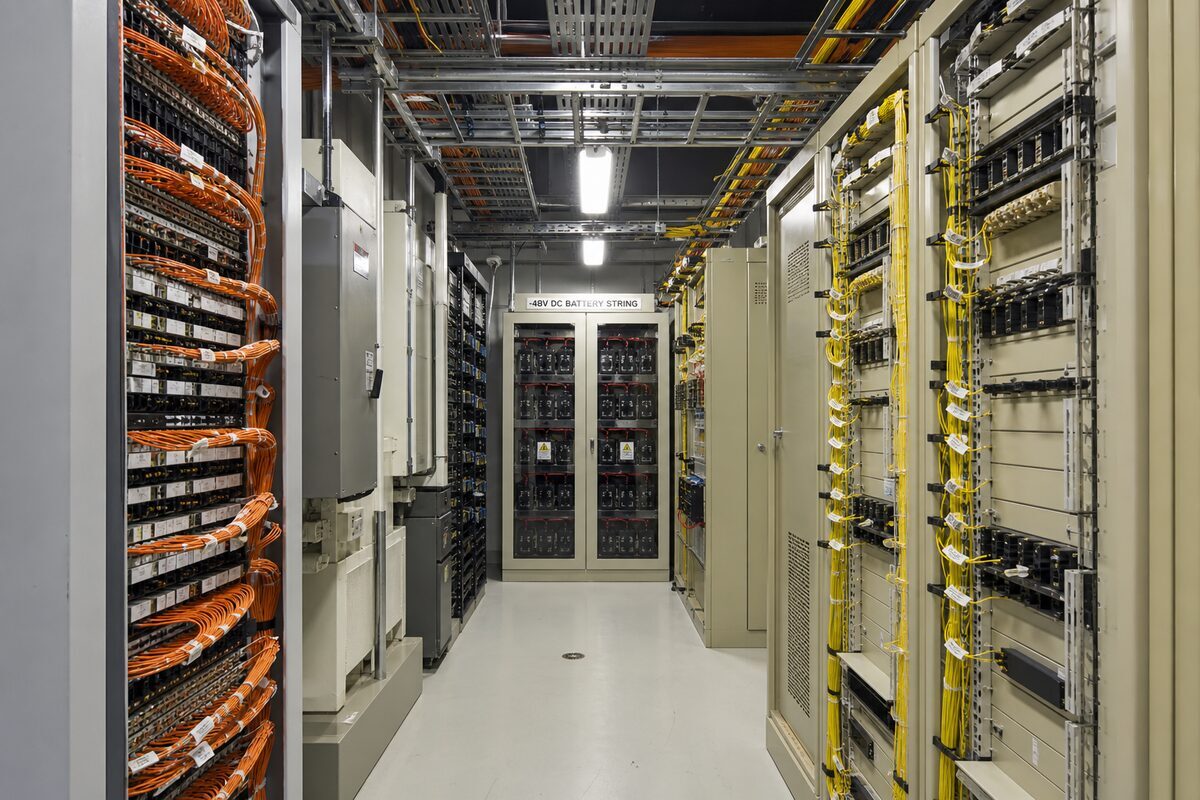
We work with telco infrastructure across Australia for carrier-grade reliability, NEBS-aligned equipment, and regional service capability for unmanned exchanges.
The telco power model is fundamentally different from enterprise IT: where data centres size UPS for 5-15 minutes of generator handover, telco exchanges design for 4-8 hours of standalone battery operation, because many regional sites have no generator at all. Battery bank design, monitoring, and maintenance is correspondingly more critical.
Fibre-to-the-node, 5G small cells, and edge compute are pushing telco power requirements into thousands of small, distributed sites that need fleet management approaches: standardised equipment, remote monitoring, and batch service contracts rather than site-by-site engineering.
Sector challenges
What makes telecommunications different.
5 critical design considerations that shape UPS architecture for this sector.
01 / 05
Long-runtime batteries
Telco exchanges typically need 4-8 hours of battery runtime, far longer than data centre 5-15 minute typicals. This drives large VRLA battery banks that require structured impedance monitoring, temperature compensation, and scheduled replacement programmes. Battery cost often exceeds UPS hardware cost.
02 / 05
DC + AC integration
Modern carrier sites mix -48V DC for legacy equipment with AC UPS for newer IT loads. Design must coordinate both systems safely, including earth-bonding between DC and AC grounds, battery bank isolation, and protection coordination. Dual-bus architectures add complexity.
03 / 05
Unmanned site service
Edge sites and regional exchanges are typically unmanned. There is nobody onsite to notice a UPS alarm. Service contracts must include alarm-driven dispatch, remote monitoring integration, and replacement-on-failure logistics with parts pre-positioned at regional hubs.
04 / 05
Fleet scale
Major carriers operate thousands of sites. UPS service must scale to fleet level: standardised equipment across sites, centralised monitoring, batch service scheduling, and single-supplier accountability. Our fleet management contracts deliver this at scale.
05 / 05
Environmental exposure
Many telco sites (roadside cabinets, rooftop cells, rural exchanges) are exposed to temperature extremes, humidity, and dust. UPS and batteries must be specified for the actual environmental conditions, not laboratory conditions.
Typical configurations
UPS patterns we deploy.
- 01-48V DC plant + AC UPS (mixed architecture)
- 02Long-runtime VRLA banks (4-8 hours)
- 03High-temp tolerant UPS (outdoor cabinets)
- 04Edge-site small UPS (1-3kVA)
- 05Modular UPS for carrier data centres
- 06Remote monitoring (SNMP/Modbus)
Equipment
Recommended for this sector.
Manufacturer-trained installation and service across all major UPS brands.
- Eaton 93PM (carrier data centres)
- APC Galaxy VS (exchange rooms)
- PowerShield Commander (edge sites)
- Eaton 5PX (small exchange, 1-3kVA)
- Vertiv Liebert GXT5 (edge sites)
- Vertiv NetSure DC plant
- VRLA long-runtime battery banks (Vision, Yuasa)
When it matters
Real-world scenarios.
What goes wrong without proper UPS, and how the right architecture prevents it.
Scenario 01
Exchange battery bank failure after 10 years
A regional exchange VRLA battery bank, installed 10 years ago and never impedance-tested, fails to deliver any meaningful runtime during a genuine power outage. The exchange goes offline, and thousands of customers lose voice and data service for 6 hours until a generator is trucked in. Annual impedance testing would have flagged the bank for replacement 2-3 years earlier.
Scenario 02
5G edge site overheats
A 5G edge site UPS in an outdoor cabinet fails during a summer heatwave because the batteries exceeded thermal limits. The cell site drops offline during peak usage. Specifying high-temperature batteries and active cooling in outdoor cabinets prevents this failure mode.
Scenario 03
Remote monitoring catches failing module
SNMP monitoring on a regional exchange UPS detects a rectifier module degradation alarm. A replacement module is dispatched to the nearest regional hub before the next scheduled visit. The swap is performed during the routine service visit: no emergency mobilisation, no service interruption. This is the value of fleet monitoring at scale.
Our services
Relevant services for telecommunications.
Frequently asked questions
4 questions answered.
Q01
Why do telco sites need 4-8 hours of battery runtime?
Many regional telco exchanges and cell sites have no standby generator, so the battery bank IS the backup. Runtime must cover the typical utility restoration time for the region, which can be 4-8 hours in rural areas (longer during storm events). Metropolitan sites with generators may only need 15-30 minutes for handover. The runtime specification is a site-by-site decision based on utility reliability history, generator availability, and service-level agreements.
Q02
How do you manage service across thousands of sites?
Fleet management: standardised equipment specs across site classes, centralised SNMP/Modbus monitoring for all sites, predictive battery replacement based on impedance trending, batch service scheduling by geographic region, and single-supplier contract management. We report monthly on fleet health metrics (battery state-of-health, alarm counts, service compliance) so you have visibility across the entire portfolio.
Q03
Can you service both -48V DC and AC UPS systems?
Yes. Our technicians are trained on both -48V DC power plant (rectifiers, battery banks, distribution frames) and AC UPS systems. Many carrier sites have both: DC for legacy telco equipment and AC UPS for newer IT and compute loads. We service the complete power chain in a single visit.
Q04
What monitoring integration do you support?
We support SNMP (v2c and v3), Modbus TCP/RTU, dry-contact alarms, and integration with major network management systems (NMS) including SolarWinds, PRTG, and carrier-specific platforms. For new installations, we configure monitoring as part of commissioning. For existing fleet, we can audit and standardise monitoring configuration across all sites.
Specify telecommunications