Industry
UPS for Retail, POS & Commercial Buildings | Australia
Retail and commercial real estate UPS work spans store-level POS protection, shopping centre comms rooms, building management systems (BMS), corporate office IT, and lift/life-safety integration. UPS Services delivers fleet UPS programmes across single-phase store networks and three-phase HQ systems.
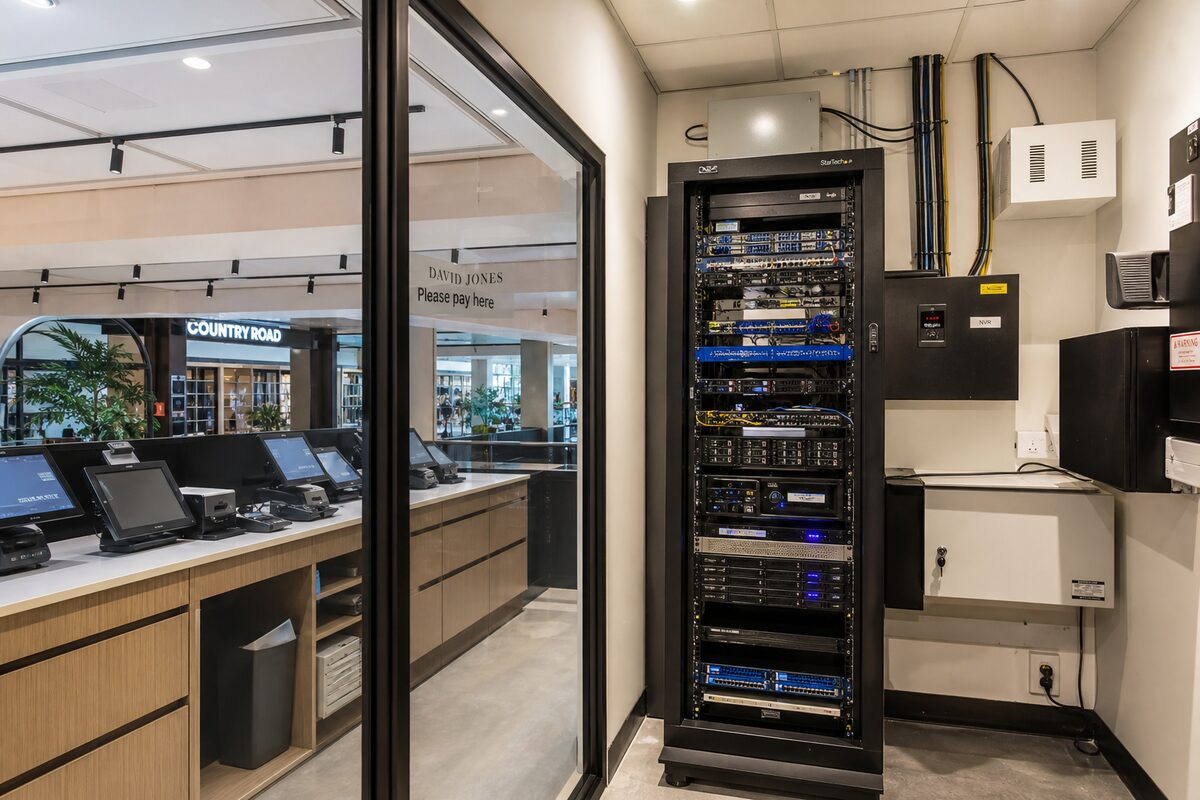
For multi-store retailers, the economics are simple: a POS outage during trading hours costs revenue directly. A 1kVA UPS per POS cluster costs a fraction of one hour of lost trade. The challenge is not justifying individual UPS; it is deploying, monitoring, and maintaining UPS across hundreds of locations consistently.
Commercial property managers face different requirements: BMS continuity for HVAC and access control, lift emergency power compliance with the BCA, emergency lighting backup, and comms room protection for building-wide networking. These are often life-safety requirements, not just convenience.
We offer fleet service contracts for retailers (50-500+ stores), commercial property portfolios, and corporate office networks: standardised equipment, centralised monitoring, and geographic batch service scheduling.
Sector challenges
What makes retail & commercial different.
5 critical design considerations that shape UPS architecture for this sector.
01 / 05
Fleet logistics
Multi-store retailers benefit from a single national UPS supplier: consistent equipment, service contracts, and on-call response across all locations. Our fleet contracts include standardised equipment specs, bulk battery replacement scheduling, and geographic service batching to minimise per-store cost.
02 / 05
Life-safety integration
BCA requires emergency lighting and lift-rescue UPS to specific runtime durations. These are life-safety systems, not optional. UPS design must comply with AS 2293 (emergency lighting) and AS 1735 (lifts), and service records must demonstrate ongoing compliance for building certification.
03 / 05
POS uptime economics
The cost of POS downtime during trading hours is directly measurable in lost revenue. Even a 10-second power dip can cause payment terminal reboots and transaction failures during peak trading. UPS payback is typically measured in weeks, not years.
04 / 05
Property management requirements
Commercial landlords require tenants to maintain UPS for BMS, access control, and fire detection systems. Service documentation must be available for building compliance audits and insurance requirements.
05 / 05
Compact form factor
Retail and office environments have limited space for UPS equipment. Rack-mount and under-desk UPS form factors are preferred. Lithium-ion batteries reduce size further where budget allows.
Typical configurations
UPS patterns we deploy.
- 01Single-phase store UPS (1-3kVA per POS cluster)
- 02Three-phase shopping centre UPS
- 03BMS UPS protection
- 04Lift emergency battery integration
- 05Emergency lighting UPS
- 06Corporate comms room UPS
- 07Remote SNMP monitoring per site
Equipment
Recommended for this sector.
Manufacturer-trained installation and service across all major UPS brands.
- APC Smart-UPS (POS, 1-5kVA)
- Eaton 5PX (comms rooms, rack-mount)
- Eaton 9PX (office, 1-11kVA)
- PowerShield Commander (BMS)
- Vertiv Liebert GXT5 (retail, compact)
- APC Galaxy VS (shopping centre, 10-150kW)
- SNMP network management cards (fleet monitoring)
When it matters
Real-world scenarios.
What goes wrong without proper UPS, and how the right architecture prevents it.
Scenario 01
POS outage during peak trading
A fashion retailer loses all POS terminals in a flagship store during a 30-second power dip on Boxing Day. The store processes transactions manually for 8 minutes while POS terminals reboot, losing approximately $12K in missed transactions and causing customer queue abandonment. A 1.5kVA UPS per POS cluster ($600 investment) would have prevented the outage entirely.
Scenario 02
BMS failure drops building HVAC
A commercial building BMS controller loses power during a brief mains event. The HVAC system drops to fail-safe mode, affecting temperature control across 12 floors for 2 hours until the BMS is manually restarted. A 2kVA UPS on the BMS controller maintains continuity through any power event within battery runtime.
Scenario 03
Lift emergency power non-compliance
A building compliance audit identifies that the lift emergency power batteries have not been tested or replaced in 7 years. The building manager faces a compliance finding and immediate remediation requirement. Annual battery testing and scheduled replacement per AS 1735 prevents this.
Our services
Relevant services for retail & commercial.
Frequently asked questions
4 questions answered.
Q01
What UPS do I need for a retail POS system?
A typical retail POS cluster (terminal, EFTPOS, receipt printer, barcode scanner) draws 300-500W. A 1-1.5kVA line-interactive UPS provides 15-30 minutes of runtime, enough to ride through power dips and brief outages, and to perform orderly shutdown if the outage is extended. For stores with multiple POS clusters, one UPS per cluster or a single larger UPS with distribution is appropriate. We recommend SNMP-monitored units for fleet visibility.
Q02
How do fleet service contracts work for multi-store retailers?
We survey the entire store network, categorise sites by UPS requirements, standardise equipment specifications, and establish a rolling service schedule by geographic region. Each quarter, a batch of stores in a city/region is serviced: battery testing, visual inspection, alarm review. Monthly fleet health reports flag any sites needing attention. Bulk battery replacement is scheduled based on impedance trending, not just age. This approach reduces per-store cost by 20-35% compared to ad-hoc service.
Q03
What are the BCA requirements for lift emergency power?
AS 1735 (Lifts) and the Building Code of Australia require lift emergency power to enable car levelling and door opening during power failure. The battery system must deliver sufficient runtime for all lifts in the building to complete a rescue cycle. This is a life-safety requirement. Non-compliance is a building certification issue. We specify, install, and maintain lift emergency batteries to AS 1735 requirements.
Q04
Do you provide UPS for building management systems?
Yes. BMS controllers, access control panels, fire detection systems, and CCTV recording equipment all benefit from UPS protection. We specify BMS UPS for the specific load and runtime requirements, install with appropriate fire-system integration (notification contacts), and include in the building service schedule. Documentation is formatted for building compliance audits.
Specify retail & commercial