Industry
UPS for Industrial Plant & Manufacturing | Australia
Industrial sites combine PLC and SCADA systems (which cannot tolerate power loss without process upset), motor drives, and instrumentation that needs clean power. UPS Services delivers UPS for control rooms, motor control centres, and process-critical equipment across Australian heavy industry.
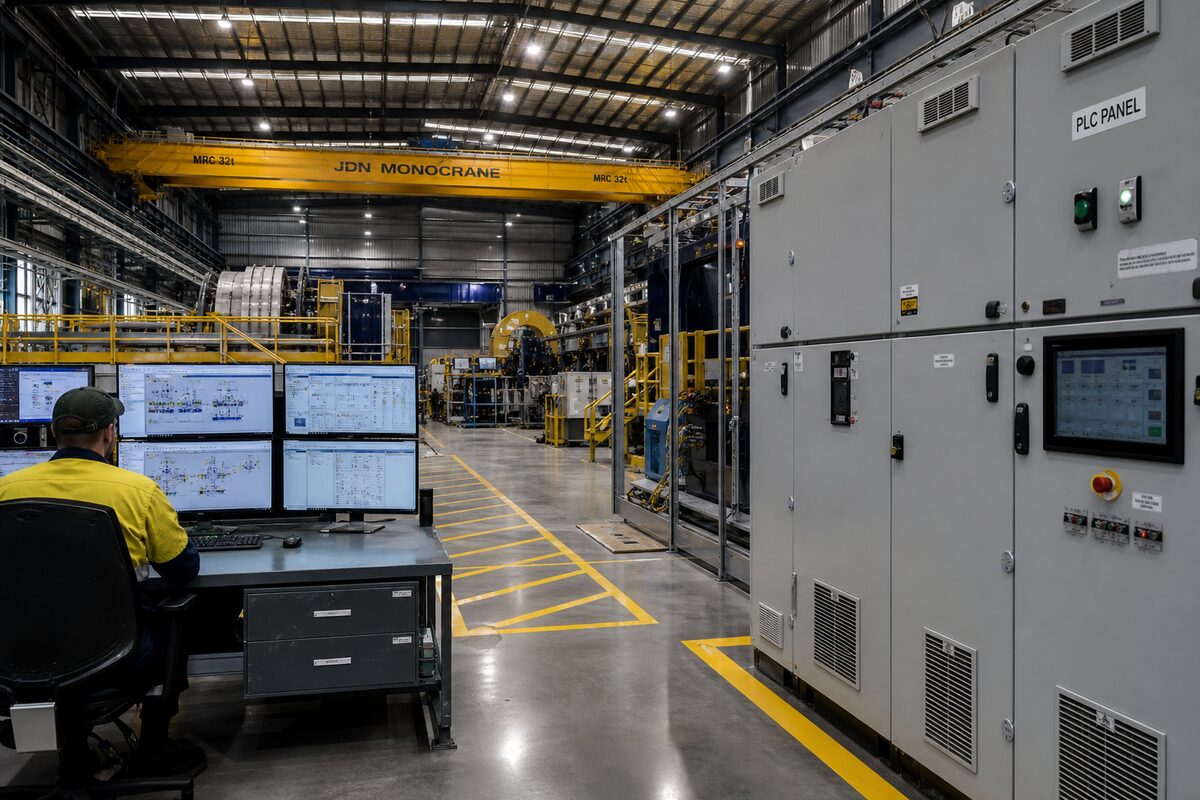
The industrial UPS challenge is power quality, not just continuity. Variable Frequency Drives (VFDs) on large motors inject harmonics back into the supply. Large motor starts cause voltage dips. Welding equipment creates transients. The UPS must protect sensitive control systems from all of these, not just mains failure.
Process upset from a brief power disruption can be extraordinarily expensive in manufacturing: a 200ms voltage dip can trip a PLC, a tripped PLC shuts down the process, and restarting a chemical or food processing line can take 4-12 hours with product losses measured in tens of thousands of dollars.
We design industrial UPS solutions that account for the real operating environment: temperature extremes, dust, vibration, harmonic-rich supply, large step loads, and the requirement for 24/7 operation with minimal maintenance windows.
Sector challenges
What makes industrial & manufacturing different.
5 critical design considerations that shape UPS architecture for this sector.
01 / 05
Harsh environment
Industrial UPS must tolerate temperature extremes (0-50°C), dust, vibration, and EMI from VFDs and large motor loads. This means conformal-coated circuit boards, sealed enclosures, anti-vibration mounting, and regular filter maintenance schedules.
02 / 05
Process upset cost
Even brief power dips can trip PLCs and force lengthy restart procedures. In food processing, chemical manufacturing, and continuous production, a single process upset can cost $10K-$500K in lost product, cleanup, and restart time. UPS ROI is measured in prevented upsets.
03 / 05
Power quality from VFDs
Variable Frequency Drives on large motors inject harmonic currents back into the power supply (typically 5th, 7th, 11th harmonics). These harmonics can cause UPS malfunction, neutral conductor overheating, and sensitive equipment problems. UPS with active input rectifiers or separate harmonic filtering is required.
04 / 05
Generator integration
Many industrial sites run on diesel or gas generators either full-time or as backup. Generator output has wider frequency variation and higher harmonic content than mains power. UPS must have wide input tolerance windows (±20% voltage, ±5Hz frequency) to operate reliably on genset supply.
05 / 05
Maintenance access
24/7 production environments have limited maintenance windows. UPS must be concurrently maintainable: external bypass panels and modular architecture allow service without process interruption.
Typical configurations
UPS patterns we deploy.
- 01Industrial-grade UPS (high-temp, conformal coated)
- 02Vibration-rated installation
- 03Single + three-phase mix for control and power
- 04VRLA preferred for harsh environments
- 05Wide-input UPS for generator supply
- 06Outdoor-rated enclosures (IP55+)
- 07Input harmonic filtering
Equipment
Recommended for this sector.
Manufacturer-trained installation and service across all major UPS brands.
- PowerShield TC series (high-temperature)
- Eaton 93PM (wide input, industrial)
- APC Galaxy VS (control rooms)
- Eaton 9PX (PLC/SCADA cabinets)
- Vertiv Liebert GXT5 (instrument grade)
- IP55 industrial enclosures
- Input harmonic filters (passive/active)
When it matters
Real-world scenarios.
What goes wrong without proper UPS, and how the right architecture prevents it.
Scenario 01
PLC trips from 200ms voltage dip
A food processing plant PLC trips during a 200ms voltage dip caused by a large compressor starting on the same bus. The production line shuts down, requiring 6 hours of cleanup, sanitisation, and restart. Product in process ($45K) is wasted. A 5kVA UPS on the PLC cabinet (sub-second ride-through) prevents the trip.
Scenario 02
VFD harmonics cause UPS malfunction
An industrial UPS installed near large VFD motor drives experiences repeated overload alarms despite being correctly sized for the connected load. The VFD harmonics are overloading the UPS input rectifier. Adding a passive harmonic filter on the UPS input resolves the issue.
Scenario 03
Battery failure in hot plant room
A UPS in a steel processing plant room at 42°C ambient experiences complete battery failure after 18 months. The VRLA batteries were rated for 3-5 years at 25°C. The process control system loses backup power. Specifying high-temperature batteries with accelerated replacement scheduling (or active battery cooling) addresses the thermal derating.
Our services
Relevant services for industrial & manufacturing.
Frequently asked questions
4 questions answered.
Q01
What UPS topology works best for industrial environments?
On-line double-conversion with wide input voltage tolerance (±20%) and active rectifier design. This topology: (1) isolates the load from all input power quality issues (sags, harmonics, transients), (2) handles generator supply with frequency variation, and (3) provides 0ms transfer time. For harsh environments, add conformal-coated electronics, IP55 enclosure, and anti-vibration mounting. Line-interactive UPS is not suitable for industrial environments with poor power quality.
Q02
How do I protect PLCs from power dips?
A dedicated UPS on each PLC cabinet, typically 1-5kVA single-phase, provides sub-second ride-through for voltage dips and brief outages. The UPS should be on-line double-conversion (0ms transfer) because even the 4-8ms transfer time of a line-interactive UPS can trip some PLCs. Size the UPS for the PLC, its I/O modules, HMI, and any associated networking equipment. SNMP monitoring provides alarm visibility to the control room.
Q03
Do VFDs affect UPS performance?
Yes. VFDs inject harmonic currents (primarily 5th, 7th, 11th) back into the power supply. These harmonics increase the RMS current seen by the UPS input rectifier, causing it to run hotter and potentially trip on overload even when the fundamental-frequency load is within capacity. Solutions: use a UPS with IGBT active rectifier (inherently harmonic-tolerant), or add passive/active harmonic filtering on the UPS input. We conduct power quality surveys to quantify harmonic levels before specifying UPS for industrial sites.
Q04
What maintenance schedule is appropriate for industrial UPS?
Quarterly service visits are recommended for industrial environments due to the harsher operating conditions: dust accumulation on fans and air paths, thermal stress on batteries, and vibration effects on connections. Each quarterly visit includes air filter cleaning, thermal imaging, battery impedance check, and visual inspection. Annual comprehensive service adds firmware review, load transfer testing, and full electrical safety inspection. For sites above 40°C ambient, battery impedance testing should be monthly.
Specify industrial & manufacturing