Industry
UPS for Hospitals, Clinics & Medical Facilities | Australia
Healthcare UPS work spans patient-critical equipment (ventilators, infusion pumps, monitors), high-current diagnostic imaging (MRI, CT, fluoroscopy), and back-of-house systems (HMS, PACS, switchboards). Each category has different uptime, isolation, and protection requirements, and each is governed by overlapping clinical and electrical standards.
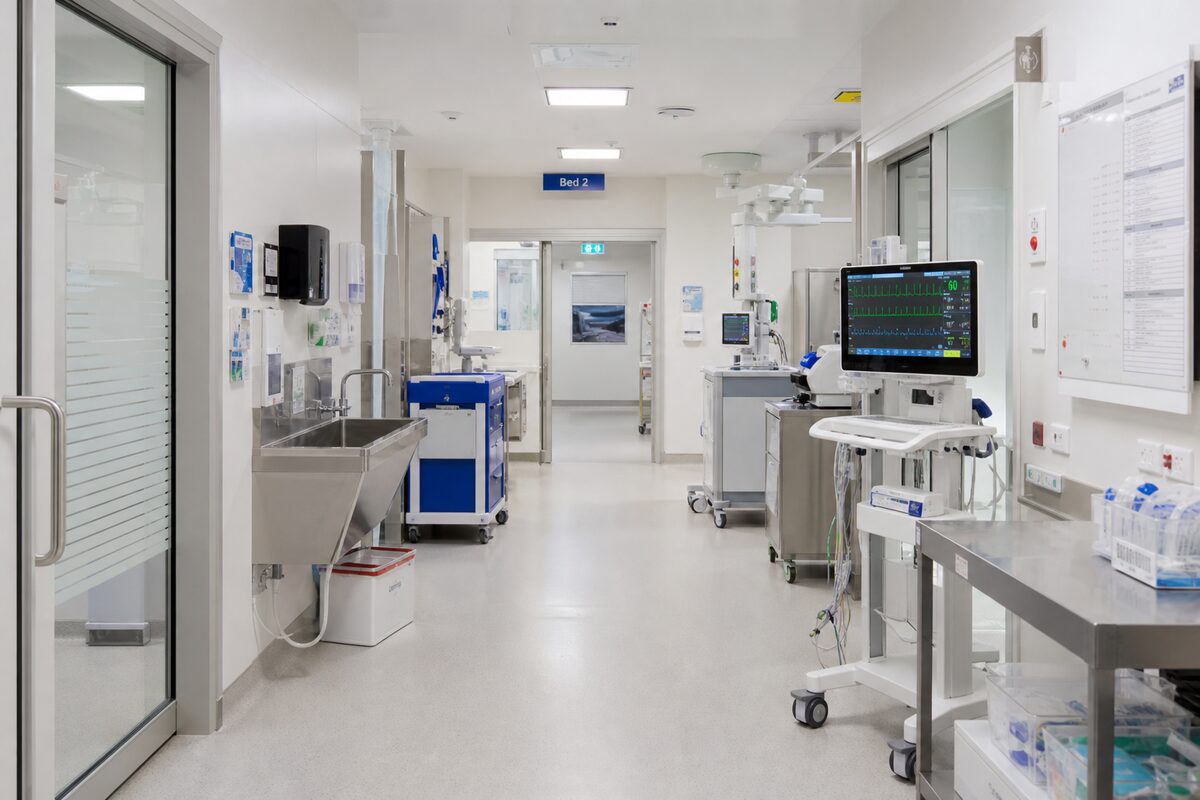
UPS Services delivers UPS for hospitals, clinics, day surgery centres, and pathology labs across Australia. Our work follows AS/NZS 3003 (medical electrical areas), IEC 60601 patient safety, and the relevant state Health Department engineering guidelines.
The consequences of UPS failure in healthcare are not measured in dollars alone. A ventilator losing power during surgery, an infusion pump resetting during chemotherapy, or a PACS system going offline during emergency radiology: these are patient-safety events. Our design approach treats healthcare UPS as life-safety infrastructure, not IT infrastructure.
We work alongside hospital electrical engineers, biomedical teams, and facilities managers to deliver power architecture that integrates with existing essential services boards, isolated power systems (IPS), and emergency generator infrastructure.
Sector challenges
What makes healthcare & medical different.
5 critical design considerations that shape UPS architecture for this sector.
01 / 05
Isolated medical IT systems
Patient-care areas, particularly cardiac-protected and body-protected zones, often require isolated power systems (IPS) with insulation monitoring per AS/NZS 3003. UPS topology must integrate with IPS panels without introducing earth-fault paths or compromising insulation monitoring accuracy.
02 / 05
EMI sensitivity in diagnostic imaging
MRI, EEG, and EMG environments are extremely EMI-sensitive. UPS selection must consider AS IEC 62040.2 EMC compliance, output filter design, and physical shielding distance. A poorly specified UPS near an MRI suite can introduce imaging artefacts that compromise diagnosis.
03 / 05
24/7 operation and service access
Patient-critical systems run continuously. Service work must be performed under bypass or scheduled around clinical activity: there is no maintenance window in a hospital ICU. External maintenance bypass panels and modular UPS with hot-swap capability are essential for non-disruptive service.
04 / 05
Essential services integration
Hospital essential services boards (ESBs) connect to emergency generators under AS/NZS 3009. UPS must bridge the 10-15 second generator start sequence and integrate with the ESB transfer logic without introducing protection coordination issues.
05 / 05
Biomedical equipment compatibility
Clinical equipment varies from 100W bedside monitors to 150kW MRI systems. UPS output must provide clean sinewave power with low harmonic distortion (<3% THD) across the full load range to prevent equipment lockups and alarm noise.
Typical configurations
UPS patterns we deploy.
- 01Isolated power systems (IPS) for cardiac-protected areas
- 02Three-phase UPS for diagnostic imaging (MRI, CT, cath lab)
- 03Single-phase UPS at point-of-care (ICU, NICU, operating theatres)
- 04Lithium-ion (small footprint, minimal ventilation)
- 05On-line double-conversion topology (0ms transfer)
- 06Distributed bedhead UPS for ICU pods
- 07Central UPS with sectionalised distribution
Equipment
Recommended for this sector.
Manufacturer-trained installation and service across all major UPS brands.
- APC Galaxy VS (imaging suites, 10-150kW)
- APC Smart-UPS (point-of-care, 1-10kVA)
- Eaton 93PM (central UPS, modular)
- Eaton 5PX (rack-mount, comms rooms)
- Vertiv Liebert GXT5 (bedside/ward, 1-10kVA)
- Vertiv Liebert APM2 (central, modular)
- PowerShield Commander (single-phase)
When it matters
Real-world scenarios.
What goes wrong without proper UPS, and how the right architecture prevents it.
Scenario 01
Ventilator power loss during surgery
An operating theatre UPS fails during surgery because the VRLA batteries were 6 years old and had never been impedance-tested. The ventilator switches to internal battery (15-30 minutes) but the surgical team must manage an unplanned power transition mid-procedure. Quarterly battery testing and proactive replacement at 80% impedance drift prevents this entirely.
Scenario 02
MRI artefacts from UPS EMI
A recently installed UPS near the MRI suite introduces high-frequency EMI that appears as ghosting artefacts on brain scans. The UPS was correctly sized but not specified for EMC compliance. Replacing the UPS with an AS IEC 62040.2 compliant model with additional output filtering resolves the imaging issue.
Scenario 03
PACS outage during emergency
The hospital PACS (radiology image archive) goes offline during a weekend mains event because the UPS battery bank had degraded below rated runtime. Emergency department clinicians cannot access prior imaging for a trauma patient. A maintenance contract with battery monitoring would have flagged the degradation months earlier.
Our services
Relevant services for healthcare & medical.
Frequently asked questions
5 questions answered.
Q01
What Australian standards apply to hospital UPS?
The primary standard is AS/NZS 3003:2018 (Electrical installations in medical areas), which defines the patient-protection classes (cardiac-protected, body-protected) and isolation requirements for medical IT systems. The UPS equipment itself must comply with AS IEC 62040.1 (safety) and AS IEC 62040.2 (EMC). State Health Department engineering guidelines add additional requirements for essential services integration. IEC 60601-1 applies to the biomedical equipment connected to the UPS, not the UPS itself, but UPS output quality must be compatible with IEC 60601 requirements.
Q02
Can UPS be installed near MRI suites?
Yes, but only with careful EMC specification. MRI environments have extremely low EMI tolerance, and stray electromagnetic fields from the UPS can introduce imaging artefacts. The UPS must be AS IEC 62040.2 compliant with low common-mode noise, and physically located outside the MRI exclusion zone (typically 5-10m depending on scanner field strength). We specify MRI-compatible UPS installations regularly and can survey the EMI environment before specifying equipment.
Q03
How do we service UPS in a 24/7 hospital without downtime?
Two strategies: (1) External maintenance bypass panels allow the UPS to be fully isolated for service while the critical load continues on raw mains, which is acceptable for scheduled maintenance during low-risk periods. (2) Modular UPS with N+1 redundancy allows individual modules to be hot-swapped without any load disruption. For cardiac-protected and ICU areas, we recommend modular N+1 as the primary strategy.
Q04
What runtime should hospital UPS provide?
Hospital UPS runtime must bridge the gap between mains failure and generator start (typically 10-15 seconds), plus a safety margin. We recommend 10-30 minutes depending on generator condition and clinical criticality. Operating theatres and ICU should be at the higher end. The runtime also needs to account for generator maintenance windows where the UPS is the sole backup.
Q05
Do you supply UPS and battery backup for NDIS and SDA housing?
Yes. NDIS participants and Specialist Disability Accommodation (SDA) dwellings often run life-supporting equipment, ventilators, suction units, powered hoists, pressure-care mattresses, electric beds and charging for power wheelchairs, that must keep running through a blackout. We size and install single-phase UPS and battery backup for NDIS and SDA homes so that critical equipment rides through an outage, and we can integrate with a generator or solar-battery system for longer autonomy. Designs follow AS/NZS 3000 and AS/NZS 5139 for any lithium battery, and we document runtime per device so support coordinators and SDA providers can evidence continuity-of-care obligations. We service NDIS and SDA backup-power systems Australia-wide with preventative maintenance and battery replacement.
Specify healthcare & medical