Industry
UPS for Universities, Research & Education | Australia
University campuses combine traditional IT data centres, distributed teaching/research facilities, HPC clusters, and sensitive lab equipment. UPS Services supports Group of Eight universities and the broader tertiary sector with both centralised data-centre UPS and distributed-fleet management.
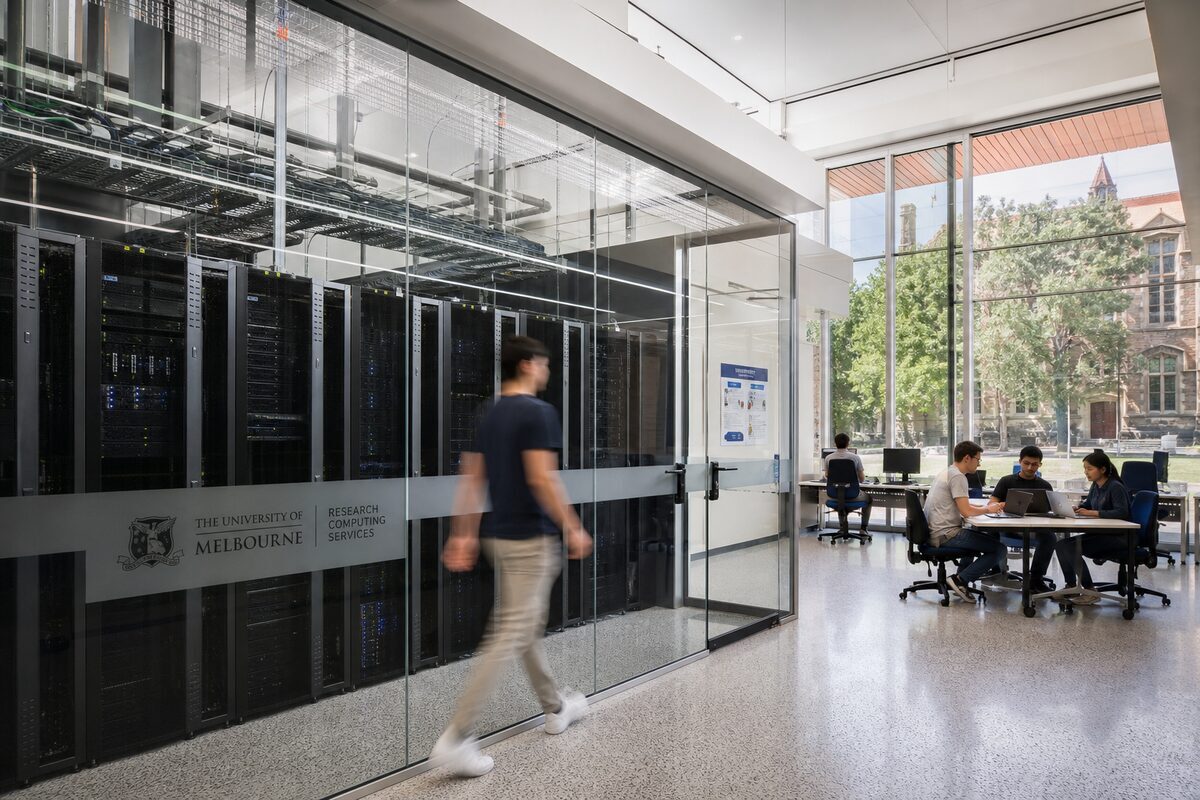
The university challenge is diversity: a single campus may have a central data centre running at Tier II/III, a physics department with sensitive spectroscopy equipment, a medical school with MRI simulators, an HPC cluster for computational research, and hundreds of small comms rooms in teaching buildings. Each has different UPS requirements.
Research equipment presents particular challenges: electron microscopes, mass spectrometers, NMR systems, and climate-controlled chambers are individually expensive and extremely sensitive to power quality. A single voltage sag can corrupt hours of experimental data or damage delicate detector components.
We offer fleet management contracts that bring consistency across the entire campus UPS estate: standardised equipment per site class, centralised monitoring, predictive battery replacement, and a single annual service schedule covering all locations.
Sector challenges
What makes education & universities different.
5 critical design considerations that shape UPS architecture for this sector.
01 / 05
HPC / research compute
Research HPC clusters increasingly run high-density GPU loads for machine learning, molecular dynamics, and climate modelling. UPS sizing follows AI/GPU patterns rather than traditional IT. See our AI/GPU industry page for detailed design considerations.
02 / 05
Fleet management across campus
Distributed UPS across many faculties benefits from centralised monitoring (SNMP integration with campus NMS), standardised equipment per site class, and pooled service contracts. This reduces per-unit service cost and improves visibility of fleet health.
03 / 05
Research instrument sensitivity
Electron microscopes, NMR systems, and spectroscopy equipment are extremely sensitive to power quality. Voltage sags, harmonics, and transients can corrupt data or damage detectors. Instrument-grade UPS with low THD output and power conditioning is required.
04 / 05
Procurement complexity
Universities often require quotes through specific procurement frameworks, preferred-supplier panels, or state government procurement processes. We are familiar with these requirements and can provide compliant quotations in the required format.
05 / 05
Teaching facility UPS
Teaching building comms rooms typically run network switches, Wi-Fi controllers, and AV equipment. A 1-3kVA rack-mount UPS with SNMP monitoring per comms room is standard. Fleet management across 50-100 comms rooms drives cost efficiency.
Typical configurations
UPS patterns we deploy.
- 01Three-phase data centre UPS (central)
- 02HPC cluster UPS (high-density)
- 03Distributed single-phase UPS in research labs
- 04Fleet UPS for teaching building comms rooms
- 05Instrument-grade UPS for sensitive research equipment
- 06Remote monitoring across campus
Equipment
Recommended for this sector.
Manufacturer-trained installation and service across all major UPS brands.
- APC Galaxy VS (data centre, 10-150kW)
- Eaton 93PM (data centre, modular)
- APC Smart-UPS (comms rooms, 1-5kVA)
- Eaton 5PX (comms rooms, rack-mount)
- Vertiv Liebert GXT5 (research labs)
- PowerShield Commander (instrument grade)
- SNMP network management cards (all brands)
When it matters
Real-world scenarios.
What goes wrong without proper UPS, and how the right architecture prevents it.
Scenario 01
Electron microscope data corruption
A 200kV transmission electron microscope in a materials science lab loses power during a 100ms voltage sag. The imaging session (4 hours of careful sample preparation and data collection) is lost. The detector requires recalibration. A 3kVA instrument-grade UPS with sub-cycle ride-through would have prevented the interruption entirely.
Scenario 02
Campus-wide UPS battery failures after heatwave
A university discovers during a summer heatwave that UPS batteries across 30 comms rooms have failed self-test. Teaching buildings lose network connectivity during a storm-related power dip. A fleet management contract with predictive battery replacement scheduling would have identified and replaced degraded batteries before summer.
Scenario 03
HPC cluster undersized UPS
A university research HPC cluster is expanded with GPU nodes for a new machine learning research programme. The existing UPS, sized for legacy CPU-based compute, cannot handle the increased power density and trips on overload. The research programme is delayed by 8 weeks for UPS replacement. Sizing the UPS for anticipated growth at initial design prevents this.
Our services
Relevant services for education & universities.
Frequently asked questions
4 questions answered.
Q01
How do you manage UPS across an entire university campus?
Fleet management: we survey the entire campus UPS estate, categorise sites by type (data centre, comms room, research lab, specialist), standardise equipment specifications per category, install centralised SNMP monitoring integrated with the campus NMS, and establish an annual service schedule covering all sites. Monthly fleet health reports give facilities management visibility of battery state-of-health, alarm conditions, and upcoming replacement needs across the entire estate.
Q02
What UPS do research instruments need?
Research instruments (electron microscopes, NMR, spectroscopy, mass spectrometry) need instrument-grade UPS with: on-line double-conversion topology (0ms transfer), low output THD (<3%), voltage regulation (±1%), and appropriate kVA sizing for the instrument plus ancillary equipment (vacuum pumps, chillers, detectors). We conduct a power-quality survey of the instrument location before specifying UPS to ensure existing power quality issues are addressed.
Q03
Can you work through university procurement processes?
Yes. We respond to formal quotation requests, preferred-supplier panel applications, and state government procurement frameworks. We provide quotes in the required format, including itemised pricing, technical specifications, compliance statements, and references from comparable tertiary-sector engagements.
Q04
What fleet size makes a managed service contract cost-effective?
Fleet management contracts become cost-effective at approximately 20+ UPS units. Below that, site-by-site service works fine. Above 20 units, the economies of scale (standardised equipment, bulk battery purchasing, geographic batch service scheduling, and centralised monitoring) reduce per-unit cost by 15-30% compared to ad-hoc service. Most university campuses have 50-200+ UPS units, well into the fleet management sweet spot.
Specify education & universities