Industry
UPS for Banking, Trading Floors & Financial Data Centres | Australia
Banking and financial services operate to extreme uptime targets driven by regulator expectations (APRA CPS 234), trading-day cycles, and customer-facing branch networks. UPS architecture must deliver concurrent maintainability and tight voltage tolerances.
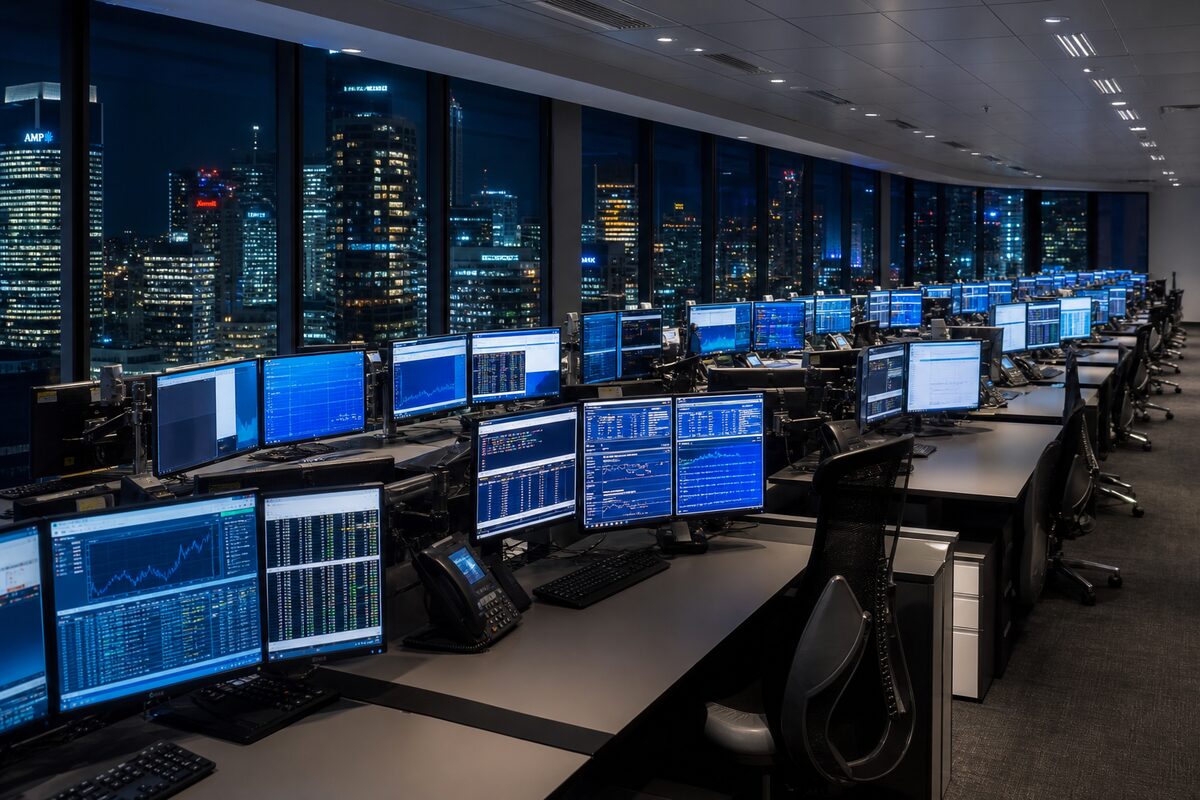
UPS Services supports tier-1 retail banks, trading floors, payment processors, and ATM network providers across Australia. We work in continuously-operating environments with strict change-management protocols.
The financial services regulator (APRA) expects documented evidence of operational resilience under CPS 234, and this extends to critical power infrastructure. Your UPS maintenance records, battery test reports, and commissioning documentation become regulatory evidence during prudential reviews. Our reporting is formatted accordingly.
Financial services UPS work spans three distinct scales: enterprise data centres (Tier III/IV), back-office and branch networks (hundreds of small UPS), and trading floor / real-time processing systems (ultra-low-latency, zero-tolerance). Each requires a different approach to design, service, and reporting.
Sector challenges
What makes banking & financial services different.
5 critical design considerations that shape UPS architecture for this sector.
01 / 05
Change-window discipline
Service work must run inside narrow approved change windows, typically Saturday night for trading systems, or during non-trading hours for branch networks. We deliver change-controlled service packages with pre-approved scope, scheduled execution, and documented completion within the agreed window.
02 / 05
Regulatory audit trail
CPS 234 expects documented evidence of operational resilience, and our service reports are formatted for direct evidence inclusion in regulator-facing audits. Battery test records, commissioning reports, and maintenance logs all follow a consistent, auditable format across your entire UPS estate.
03 / 05
Branch / ATM network scale
Branch networks involve hundreds of small UPS units across the country. A fleet management approach (centralised monitoring, standardised equipment, scheduled batch service by region, and pooled spare-parts inventory) drives lifecycle economics and consistent uptime across all locations.
04 / 05
Trading floor zero-tolerance
Trading systems cannot tolerate any power disruption. Even a 4ms transfer to bypass can cause TCP session drops on high-frequency trading platforms. On-line double-conversion UPS with zero transfer time is mandatory, combined with 2N redundancy for the trading floor power chain.
05 / 05
Vendor concentration risk
APRA expects banks to manage vendor concentration risk. We provide multi-brand capability (APC, Eaton, Vertiv, PowerShield) so your UPS estate is not single-vendor dependent. We also maintain relationships with all major UPS manufacturers for warranty and parts support.
Typical configurations
UPS patterns we deploy.
- 01Tier III/IV data centre topology
- 022N dual-bus power
- 03Three-phase modular UPS
- 04Lithium-ion (footprint, lifecycle)
- 05Concurrently maintainable bypass
- 06Branch network fleet UPS (1-3kVA)
- 07ATM-dedicated UPS with remote monitoring
Equipment
Recommended for this sector.
Manufacturer-trained installation and service across all major UPS brands.
- APC Galaxy VL (data centre, modular)
- Eaton 93PM (data centre, modular)
- Vertiv Liebert APM2 (data centre, modular)
- APC Smart-UPS (branch/ATM, 1-5kVA)
- Eaton 5PX (branch, rack-mount)
- PowerShield Commander (branch)
- Lithium-ion battery systems (all brands)
When it matters
Real-world scenarios.
What goes wrong without proper UPS, and how the right architecture prevents it.
Scenario 01
Trading floor TCP session drops
A trading floor experiences a 4ms power micro-interruption during a UPS transfer to bypass for scheduled maintenance. High-frequency trading systems drop TCP sessions, causing missed trades during a volatile market session. The financial impact exceeds $500K. A 2N architecture with zero-transfer-time UPS would have eliminated the disruption.
Scenario 02
Branch UPS battery failure cascade
A retail bank discovers that 40% of its branch UPS batteries are beyond rated life after a hot summer causes widespread self-test failures. The bank faces a fleet-wide battery replacement programme: 300+ sites in 6 weeks before storm season. Fleet monitoring and predictive replacement scheduling prevents this fire-drill scenario.
Scenario 03
APRA audit finding on UPS documentation
During a CPS 234 prudential review, APRA flags missing UPS maintenance records for 18 months at two data centre facilities. The bank must produce evidence of operational resilience or face remediation requirements. Structured, audit-ready service reporting from day one avoids this regulatory exposure.
Our services
Relevant services for banking & financial services.
Frequently asked questions
4 questions answered.
Q01
What does APRA CPS 234 require for UPS infrastructure?
CPS 234 (Information Security) requires regulated entities to maintain the resilience of information assets, which explicitly includes supporting infrastructure like power systems. While CPS 234 does not prescribe specific UPS configurations, it requires: documented risk assessment of information asset infrastructure, evidence of operational resilience (maintenance records, test reports), incident response and recovery plans, and periodic testing of business continuity arrangements. Our UPS service reports are formatted as direct evidence for CPS 234 prudential reviews.
Q02
How do you manage UPS across 200+ bank branches?
Fleet management: standardised equipment specifications across branch types, centralised SNMP monitoring, predictive battery replacement based on age and impedance trending, geographic batch service scheduling (all branches in a city serviced in the same week), and pooled spare parts inventory. We report monthly on fleet health metrics and flag any sites requiring attention before the next scheduled visit.
Q03
What UPS topology suits a trading floor?
Trading floors require on-line double-conversion UPS (0ms transfer time) with 2N redundancy. Even a brief transfer to bypass can cause TCP session drops on high-frequency trading systems. We recommend modular 2N with static transfer switches (STS) for automatic failover between independent UPS buses. The complete power chain (UPS, distribution, PDU) must be dual-corded.
Q04
Do your reports meet PCI-DSS requirements?
Yes. For environments handling cardholder data, our reports include the infrastructure security evidence required by PCI-DSS Requirement 9 (physical access controls) and Requirement 12 (information security policy). This includes UPS access logs, maintenance records, battery test data, and environmental monitoring history. Reports are formatted for QSA review.
Specify banking & financial services